
If you are reading this, you have likely seen the price tag. You’ve looked at the permit fees, the flight costs to East Africa, and the price of Eco-lodges tucked away in the misty mountains. You’ve probably asked yourself: “Is spending thousands of dollars for exactly sixty minutes with a group of overgrown apes actually worth it?”
It’s a valid question. In a world where you can see high-definition wildlife documentaries from your couch or visit a local zoo for the price of a pizza, the financial barrier to gorilla trekking can feel staggering.
But as someone who has navigated the “Impenetrable” forests of Uganda and the volcanic slopes of Rwanda, I can tell you that this isn’t just a “zoo visit” on steroids. It is a soul-stirring, perspective-shifting encounter that defies a simple line item on a budget.
Here is the breakdown of the costs, the experience, and the ultimate verdict on whether gorilla trekking is worth your hard-earned money in 2026.

To understand if it’s “worth it,” we first have to look at the cold, hard numbers. You cannot simply walk into the forest; you need a permit. These permits are strictly regulated to protect the gorillas from overexposure and disease.
| Destination | Permit Cost (2026) | The “Vibe” |
| Uganda | $800 | The “Value-Luxury” choice. Raw, wild, and adventurous. |
| Rwanda | $1,500 | The “High-End” choice. Exceptional infrastructure and shorter drives. |
| DR Congo | $400 | The “Adventurous” choice. Lower cost, but higher logistical complexity. |
The permit is just the beginning. When you factor in boutique forest lodges, 4×4 transport, bush flights, and tipping your trackers and porters, a 3-day “Standard” gorilla safari usually ranges from $1,800 to $4,500 per person. If you’re looking at ultra-luxury lodges in Rwanda, that number can easily climb to $7,000+.
When you pay for a permit, you aren’t just paying for a ticket to a show. You are paying for the survival of a species.
In the 1960s, mountain gorillas were predicted to be extinct by the end of the 20th century. Today, they are the only great ape species whose numbers are increasing. This didn’t happen by accident. Your permit fee directly funds:
24/7 Ranger Security: To protect families from poachers.
Veterinary Care: The “Gorilla Doctors” who perform life-saving surgeries in the wild.
Habitat Protection: Keeping the “Impenetrable” forest impenetrable.
In the past, local communities often saw gorillas as a threat to their crops or a source of bushmeat. Today, 10–20% of permit revenue is funneled back into local villages to build schools, health clinics, and clean water systems. When you trek, the locals become the gorillas’ fiercest protectors because the “Gentle Giants” are now their primary source of economic stability.
The “trek” itself is half the adventure. You’ll find yourself hacking through dense vines, sliding down muddy slopes, and breathing in the scent of wild celery and ancient moss. It is physically demanding, humid, and occasionally exhausting.
And then, everything changes.
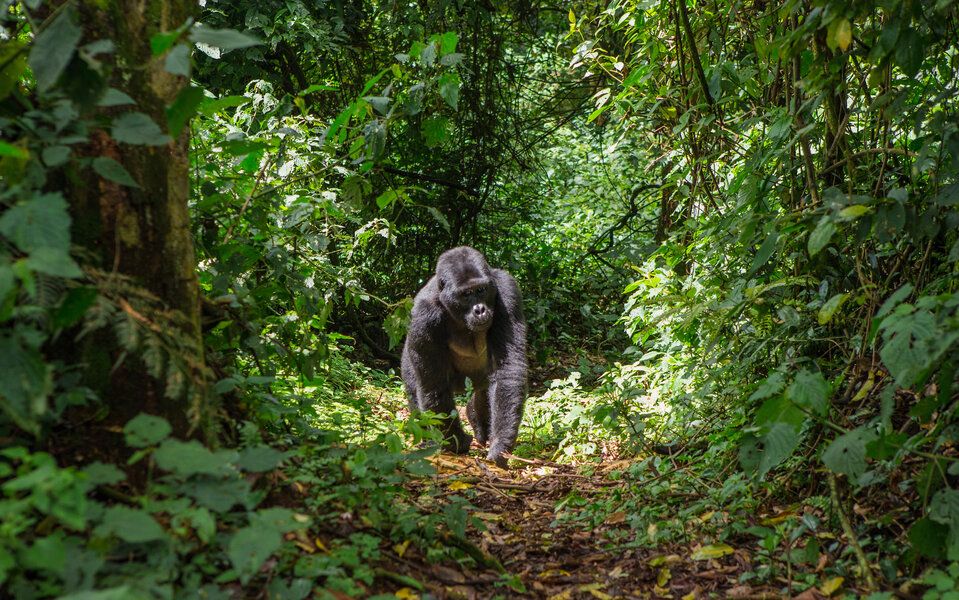
Your tracker pauses, signals for silence, and points into a thicket of emerald leaves. You see a patch of black fur. Then, a massive, chestnut-colored eye meets yours.
Humans share roughly 98% of our DNA with gorillas. You don’t realize what that means until you watch a mother gorilla cradle her infant, or see a juvenile play-wrestle with its brother. Their expressions—mischief, boredom, tenderness, and curiosity—are hauntingly familiar.
Nothing prepares you for the sheer gravity of a Silverback. Weighing up to 450 pounds, he is a mountain of muscle and authority. Yet, despite his power, the atmosphere is usually one of profound peace. You are a guest in his living room, and as long as you respect the rules, he treats you with a regal, quiet indifference.
To give you an honest answer, let’s look at the trade-offs.
Exclusivity: Only 8 people per day are allowed to visit a specific gorilla family. It’s one of the quietest, most intimate wildlife encounters on Earth.
The “One-Time” Factor: For most people, this is a “bucket list” item. You aren’t paying for a commodity; you’re paying for a memory that will be told at dinner parties for the next 40 years.
Direct Impact: You can see exactly where your money goes—from the boots on the rangers’ feet to the lack of snares in the forest.
The Time Limit: Spending $800–$1,500 for just one hour feels “unfair” to your wallet. (Though many argue that 60 minutes is the perfect amount of time to be present without the distraction of a camera lens).
Physicality: This isn’t a safari where you sit in a jeep with a gin and tonic. You will sweat, you will get muddy, and you might get rained on.
No Guarantees: These are wild animals. While the success rate is about 98%, there is always a tiny chance they move into an inaccessible area.
If the cost is the sticking point, here are three ways to maximize your value:
Choose Uganda over Rwanda: By choosing Bwindi Impenetrable Forest, you save $700 on the permit alone. That’s enough to fund your entire accommodation or an extra flight.
Hire a Porter: For about $20, you can hire a local porter to carry your bag and help you navigate the slopes. It makes the trek easier for you and provides a direct, vital income to a local family.
The “Habituation” Upgrade: In Uganda, you can opt for the Gorilla Habituation Experience. For $1,500 (the same price as a standard Rwanda permit), you get four hours with the gorillas instead of one. For photographers and enthusiasts, this is the gold standard of value.
Is gorilla trekking worth the cost?
If you view it as a transaction—paying $25 per minute for a “viewing”—the math might not make sense.
However, if you view it as an investment, the answer is a resounding YES. You are investing in the survival of a prehistoric lineage. You are investing in the development of African mountain communities. And most importantly, you are investing in a moment of clarity where the line between “human” and “nature” vanishes.
Most travelers leave the forest exhausted, covered in mud, and slightly poorer in the bank—but they almost always say the same thing:
“I would pay double to do it all over again.”
What do you think? Is a face-to-face encounter with a Silverback on your bucket list for 2026, or does the price tag keep it out of reach?

Ready to explore the wild beauty of Africa? Tell us your travel interests below and our safari experts will respond to provided email within 2 minutes & absolutely free.


